






A Structured Placement Ecosystem
for MBA Institutions

Industry-Aligned. Outcome-Focused. Placement-Driven.

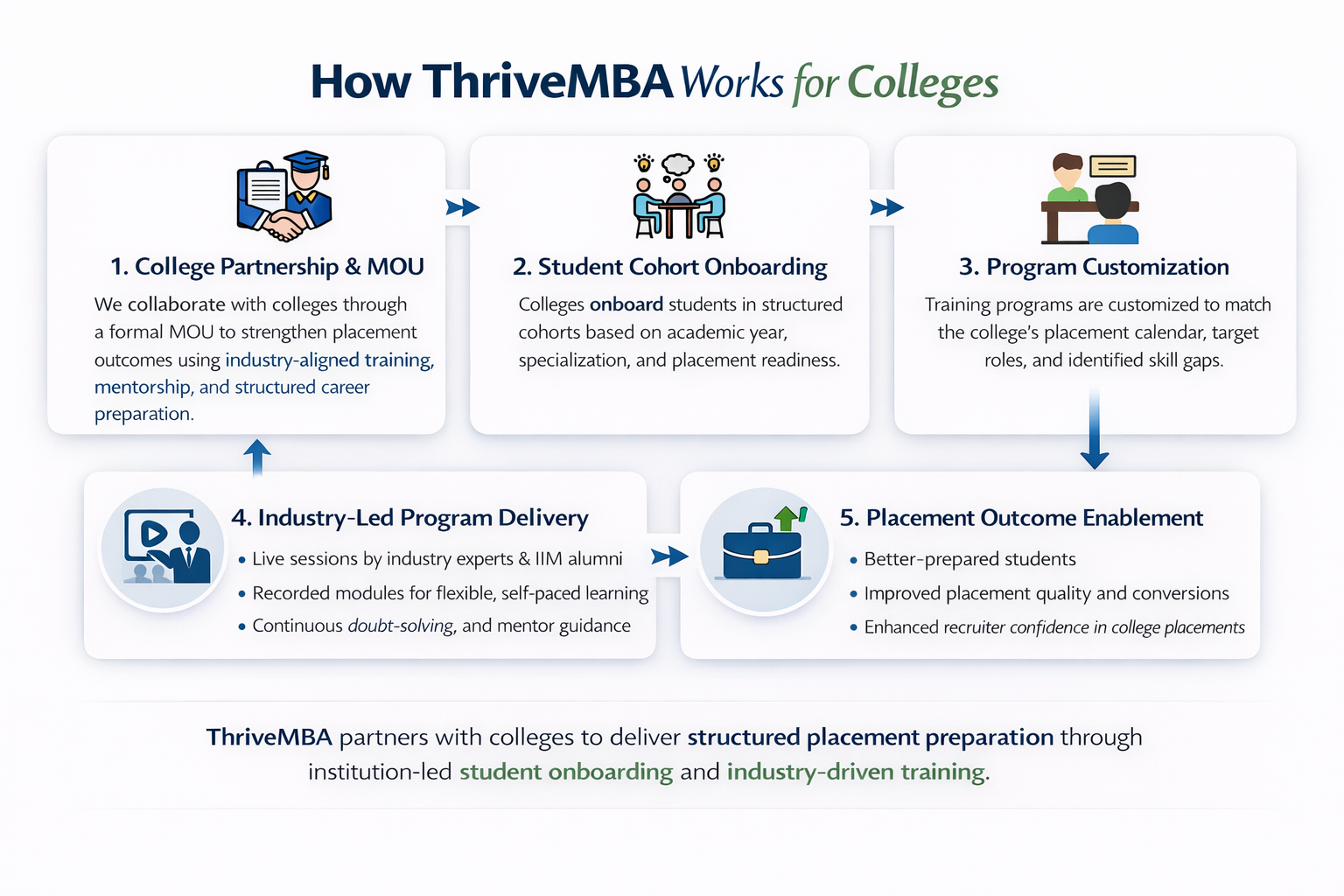
We partner with MBA institutions through formal MOUs to design and deliver

role-specific, recruiter-aligned placement readiness programs integrated

with campus placement processes.

An Initiative by IIM Alumni

Backed by mentors from IIMs, IITs & industry

0 +

Students Mentored

0 +

Sessions Conducted

0 %

Performance Improvement

Why ThriveMBA?

A structured ecosystem for placement

Internship

Mandatory internship exposure providing practical industry experience and application of learning to ensure placement readiness and profile building

Live Sessions

Live interactive sessions led by industry experts and IIM alumni, focused on concept clarity, doubt resolution, and continuous engagement to strengthen placement readiness

Mock GD + PI

Group discussions and Personal interviews are designed to reflect actual MBA placement processes, aligned to corporate expectations to ensure placement readiness

Recorded Modules

Recorded modules curated by industry experts and IIM alumni, enabling flexible, self-paced learning and revision at your own pace across key concepts

1:1 Mentorship

Structured one-to-one mentorship provided by IIM alumni’s, focused on profile building, career direction, and placement strategy aligned to your career goals and ambitions

Community

Access to a focused professional community for peer learning, networking, job support, referrals, and placement readiness through structured guidance

Trusted by IIM Faculty, Industry leaders & Recruiters

Assistant Professor, IIM Trichy
(Information Systems and Analytics Area)

Contemporary management education must move beyond theory to systematically build analytical rigor, structured thinking, and real-world problem-solving capability. ThriveMBA effectively bridges this gap by offering a well-designed experiential learning layer that complements institutional teaching. Its focus on live projects, internships, mock GD–PI processes, and role-specific preparation enables students to internalize concepts through practice rather than passive learning. A key strength of ThriveMBA lies in its employability-driven design, which delivers a clear dual benefit. First, the structured preparation enhances students’ readiness for recruitment processes, improving their ability to secure suitable roles. Second, the intensive training and simulated professional interactions provide early exposure to workplace expectations, equipping learners to transition smoothly and perform confidently once employed. For institutions, ThriveMBA functions as an industry-relevant extension of the curriculum, while for students it builds confidence, clarity, and professional maturity essential for success in today’s competitive job market.

Rajeev jha
HR, Unacademy

As recruiters, we look beyond resumes — we assess readiness, practical thinking, and job-fit. ThriveMBA prepares students exactly on these dimensions. Their structured mock GD–PI process, interview readiness, and mandatory internship exposure ensure candidates understand expectations before entering the job market. What is impressive is their focus on role-based skill development rather than one-size-fits-all training. Platforms like ThriveMBA significantly improve employability by aligning student skills with real hiring requirements, which ultimately benefits both students and recruiters.
Neelmani Karn
Amazon
From an industry standpoint, most fresh graduates struggle not because they lack degrees, but because they lack hands-on exposure and role clarity. ThriveMBA bridges this gap effectively through domain-specific training, real-world internships, and live projects that simulate actual business challenges. The platform prepares students for how work really happens in organizations — problem solving, stakeholder communication, and execution under pressure. Students who go through ThriveMBA are noticeably more industry-ready, making onboarding faster and value creation quicker for organisations.
IIM Trichy | IIT Jodhpur
Having been close to the expectations of the industry and academia in the years leading up to it, I find ThriveMBA to be a well-designed platform to address employability in a structured and outcome-oriented way. Its focus on role-specific skills development, compulsory live projects and internships and rigorous mock GD-PI preparation helps students to translate what they learn in class to actual competence. I believe that ThriveMBA has the potential to help candidates with the actual hiring needs and new industry jobs. "For institutions and partners, the platform is a promising and considerable option to improve student readiness and placement outcomes. I believe that for students, the platform has the potential to create clarity, confidence, and practice needed to succeed in today's competitive job market."
The session conducted by ThriveMBA was highly insightful and well-structured, delivering meaningful value to students across multiple dimensions of employability. The coverage spanned resume building, interview preparedness, emerging job roles, AI tools, and evolving industry expectations, along with practical guidance on professional presentation and mock interviews. The session successfully bridged conceptual understanding with real-world applicability, enabling students to gain clarity on career pathways and skill requirements. The engagement was impactful and relevant, and we look forward to exploring future collaborations with ThriveMBA.​
“ThriveMBA demonstrates a strong understanding of how academic learning can be meaningfully extended through structured industry exposure. Its focus on live projects, internships, and role-specific skill development creates tangible value for students while remaining aligned with institutional objectives. The platform’s emphasis on employability outcomes, practical readiness, and evolving industry requirements makes it a promising partner for collaboration. I see clear potential for value creation through joint initiatives that enhance student preparedness and strengthen the academic–industry interface.”